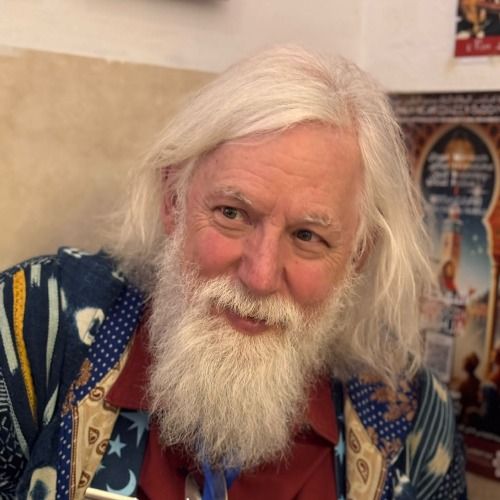
The Red Thread of the Soul: Dancing with Ghosts and Cracked Pots
Our Guest - Maria Credali
Maria has been commissioned to tell stories for The Royal Shakespeare Company, Festival at the Edge, Toronto, Galway Moth and Butterfly, Listowel, Montreal, and Marrakech International Storytelling festivals and many beautiful heritage venues. She has also featured at Stafford and Wolverhampton Literary Festivals and delivered workshops and talks for The Society for Storytelling, the Storytellers in Schools forum, and The Might Creatives “Sharing Creative Practice” forum.
Maria tells traditional and contemporary stories with a warm, engaging, and intimate style. She will leave you with a warm heart and smile on your face. Her storytelling has been described as spellbinding, mesmerising, humorous and entertaining. Creating a safe, warm and welcoming atmosphere whenever she tells, Maria curates the perfect place to let your imagination run free as you listen.
The Stories
- The Cracked Pot – Told by Maria Credali. A timeless tale of a vessel that believes it is broken, only to discover it has been watering the flowers on the path all along.
- The Magic Wine Cup – Told by Jim Brulé. A Jewish Passover miracle set in Morocco, exploring the restoration of loss through the power of community.
- Nancy May – Told by Maria Gillen. A chilling Cork legend of a midwife caught between the human world and the idir (the in-between) of the fairy folk.
- Eileen and her Fisherman – Told by Maria Credali. A hauntingly beautiful story of a love that transcends death and a dance that never ends.
The Hook
In this inaugural guest episode, Maria and Jim are joined by the "Mad for Road" storyteller Maria Credali. Together, they weave a tapestry of tales that travel from the dusty paths of Marrakesh to the cobblestone streets of Cork, exploring how stories act as medicine for the "cracked" parts of our lives and a bridge for those standing at the threshold of the end.
The Chapters
- [00:00] The Story Road from Marrakesh to New York: The hosts introduce guest Maria Credali and discuss the "Story Bridges" project connecting Ireland, Morocco, and the US.
- [03:30] The Cracked Pot: Maria Credali shares a story about imperfection, reminding us that our "flaws" are often the very things that nurture the world around us.
- [11:00] Seven Years a Wolf: A discussion on Maria’s medieval-inspired show about resilience, betrayal, and finding a sense of self through service.
- [16:30] The Magic Wine Cup: Jim tells a story of Rabbi Pinto in Morocco, illustrating how miracles occur when we return from isolation to the heart of the community.
- [24:45] Nancy May & The Fairy Midwife: Maria Gillen recounts the Cork version of a legendary midwife’s encounter with the sidh and the high price of seeing too much.
- [45:30] The Universality of Place: The group explores how stories travel across oceans, changing their "local" details while keeping their ancient, universal heart.
- [48:00] Eileen and her Fisherman: A story of grief and a Halloween dance that serves as a beautiful metaphor for the enduring connection between the living and the dead.
- [01:01:00] Stories as a Final Gift: Jim shares his experience as a death doula, and Maria G. recounts her mother’s final blessing: "You can tell my stories now."
Key Takeaways
- The Blessing of the Crack: Our perceived failures or "cracks" are often the channels through which we provide the most beauty and nourishment to others.
- The "Idir" (In-Between): Folklore often warns us of the "in-between" spaces, but these are also the places where healing and magic are most accessible.
- Community as a Cure for Grief: Both the "Magic Wine Cup" and the discussion on the end of life highlight that isolation deepens loss, while community provides the vessel for miracles.
- Stories as Inheritance: Passing on a story is a sacred act of lineage; it is a way to ensure that the spirit of a person or a place remains "off dancing" rather than truly gone.
- Visual vs. Logical Telling: A fascinating look at how different storytellers build worlds—some through internal images and others through the rhythmic construction of space.
Closing
Thank you for joining us on the Story Road. To dive deeper into the myths that move us, subscribe to the Healing Monsters Substack.
Seo iad ár scéalta - these are our stories.
Transcript
Hello from Cork.
Speaker:Hello from New York.
Speaker:Is mise Máire, Seanchaí Corcaí.
Speaker:It's Maria, the Cork-based storyteller.
Speaker:It's me, Jim, here in Fayetteville, New York.
Speaker:We can't wait to tell you a few stories.
Speaker:Well, the interesting people that you meet on the story road, it's
Speaker:only marvelous, isn't it, Jim?
Speaker:It certainly is.
Speaker:It certainly is.
Speaker:And tucked in between Maria and Jim today, we have another Maria.
Speaker:It's such a beautiful name and I think it's a name that
Speaker:suits storytellers very well.
Speaker:So Maria Credali, how are ya?
Speaker:Hi.
Speaker:I am good.
Speaker:It's great to be here.
Speaker:Thanks for inviting me along.
Speaker:Oh, it's great to have you here, you know.
Speaker:And I suppose we have to go back to the World Storytelling Cafe and say that
Speaker:we've all met on those hallowed roads.
Speaker:So Maria, you haven't met Jim, um, in person yet, but I'm sure you will.
Speaker:But you and I, we had a little dance there in the World Storytelling Cafe
Speaker:for the International Storytelling Festival in Marrakesh, didn't we?
Speaker:We did.
Speaker:It was so lovely to meet everybody after all those months and months
Speaker:of seeing each other in little boxes on Zoom meetings, and then we
Speaker:all just got to meet in the flesh.
Speaker:It was just, it was wonderful actually.
Speaker:Yeah.
Speaker:It was the start of a lot of really lovely friendships, that was.
Speaker:Yeah, absolutely.
Speaker:You know, and I am, I'm looking forward to going back very shortly now, uh, we've
Speaker:been, we in my residency with Finouge in Sheehan's Storytelling Cottage, uh, we
Speaker:started this project called Story Bridges.
Speaker:And so Omar Belaarej came over from Marrakech last year.
Speaker:And I'm going back this year, but we're actually extending the bridge.
Speaker:So the bridge is now going to New York, Jim, isn't it as well?
Speaker:It is, it is.
Speaker:Yeah.
Speaker:And Marrakesh has really been one of the centers of that, because that's where you
Speaker:and I met face to face for the first time.
Speaker:Yeah.
Speaker:Um, but yeah, we'll be going back for, uh, about a week in, in April and,
Speaker:uh, traveling around in the country, even up into the Atlas Mountains
Speaker:to um, to do some storytelling with the Amazigh people there.
Speaker:So very, very excited about that.
Speaker:Very excited.
Speaker:That's so wonderful.
Speaker:You know, and of course we've had, uh, we haven't formalized them, but
Speaker:we've had lovely mad for road story bridges in our story homes, Maria.
Speaker:So we were over in Litchfield, um, only, yeah, very recently.
Speaker:And Birmingham as well, where I was born, you know, so, uh, Maria, have you
Speaker:a little story to start us off today?
Speaker:I have, I thought I would start with, this is one of my absolute most
Speaker:favorite stories, and I love this one because it speaks to everyone.
Speaker:Long, long ago, in a time before well, taps and plumbing, where you couldn't
Speaker:just turn the tap on and get your glass of water and you couldn't just
Speaker:hop in the shower there lived a man, and this man's job was to carry water.
Speaker:And he worked in a house on the top of the hill and every day he would pick up
Speaker:two heavy clay jars, clay pots, and he would put them on either end of a stick,
Speaker:which he carried across his shoulders, and he would begin to walk down the hill.
Speaker:And it was a long, winding, and dusty path, and it went from the house on
Speaker:the top of the hill all the way down into the cool and the shade of the
Speaker:river at the bottom of the valley.
Speaker:And there he would sit and he would relax.
Speaker:He would listen to the frog singing and the birds tweeting.
Speaker:And he would watch the dragonfly zip across the surface of
Speaker:the water and just, oh, calm.
Speaker:And he would take these pots from off his shoulder and take them over to the
Speaker:river and he would fill them up with water, hoist them back onto his shoulders.
Speaker:They were heavy now, and he'd begin to walk back up that long, winding,
Speaker:dusty path to the house on the top of the hill when he had to do this job,
Speaker:maybe five or six times a day, carrying the water from the river to the house.
Speaker:He was very happy in his work, and you'd oft to hear him singing or whistling.
Speaker:Time went on and one afternoon, and we don't really know how this happened,
Speaker:but one of those pots developed a crack.
Speaker:And now every time he was walking back from the river to the house, that
Speaker:pot, well, it would drip, drip, drip.
Speaker:By the time he got back to the house on the top, there was
Speaker:only half a pot of water left.
Speaker:But he didn't mind.
Speaker:It didn't seem to bother him one bit, but you know, it did bother the perfect pot.
Speaker:The pot with no cracks in it all, the most beautiful, perfect whole pot.
Speaker:Well, she began to mutter and whine and she would say things like,
Speaker:"What you doing with that pot?
Speaker:That pot's a load of rubbish.
Speaker:Look at it.
Speaker:It can't even do its job anymore.
Speaker:By the time you've got back up to the house at the top, there's
Speaker:only half of the water left.
Speaker:Why don't he get rid of it?
Speaker:It's useless.
Speaker:Get rid of it.
Speaker:Get another perfect pot like me!"
Speaker:Well, the man listened, but he didn't say very much.
Speaker:He doesn't say very much in this story, this man.
Speaker:But you know what?
Speaker:That poor cracked pot, it had to listen to that every day, day in and day out.
Speaker:It had to listen to somebody talking about how useless it was, how it was rubbish,
Speaker:how it couldn't do its job anymore.
Speaker:In fact, how it was making everyone else's life hard.
Speaker:And that poor cracked pot became more and more sad.
Speaker:And it realized that no, it couldn't do its job anymore.
Speaker:And it wasn't as good as it used to be.
Speaker:And it tried so hard to pull itself back together to close that crack,
Speaker:but it couldn't seem to manage it.
Speaker:And as the days turned into weeks and the weeks turned into months, that poor
Speaker:cracked pot became so despondent that one afternoon when they were down by
Speaker:the river, listening to the birds sing, watching the dragon fly zip across the
Speaker:water, it finally spoke up and in a quiet voice, it said to the man, "I know
Speaker:we've been together such a long time, and I've loved working with you, but I've
Speaker:realized that I can't do my job anymore and I know I'm making your life harder,
Speaker:and maybe it's time for us to part.
Speaker:I think perhaps you should leave me behind and get yourself a better pot.
Speaker:A pot that can carry all the water for you, that's not
Speaker:gonna make your life harder.
Speaker:Maybe it's time.
Speaker:Maybe you'd be better off without me."
Speaker:Well, the man said nothing again, but he just went over to the river and he filled
Speaker:up both of the pots with water, and he put them on either end of that pole.
Speaker:He hoisted them onto his shoulders, and they began the walk of the
Speaker:long winding dusty path to the house on the top of the hill.
Speaker:And as they walked along, that pool, cracked pot, it just dripped, dripped,
Speaker:dripped all the way up the hill.
Speaker:And as they swayed with the motion of the man's steps, the man quietly said to
Speaker:the perfect pot, "Look down and tell me what you see on your side of the path."
Speaker:And the perfect pot, "Why?"
Speaker:"Just tell me," said the man.
Speaker:And the perfect pot looked down, "Well, there's nothing, is there?
Speaker:It's too dusty, too dry for anything to grow. Why are you asking me this?"
Speaker:And the man very quietly said to the poor, cracked pot, "Look down. Tell me, what
Speaker:do you see on your side of the path?"
Speaker:And the cracked pot looked down, and all the way up his side of
Speaker:the path there grew wild flowers.
Speaker:Absolutely beautiful.
Speaker:What did you think of that, Jim?
Speaker:Oh, beautiful.
Speaker:Yeah.
Speaker:Oh, what a beautiful story.
Speaker:And so very, very sweetly told.
Speaker:Thank you.
Speaker:Thank you, thank you.
Speaker:It's such, I think it's such an important story to, to share
Speaker:for, for all ages actually.
Speaker:It's really interesting that one works right across the ages
Speaker:from little children to adults.
Speaker:And it's like, I always kind of, I don't explain why the flowers grew,
Speaker:I don't explain about the water.
Speaker:And we kind of like, if it's families with small children who
Speaker:are listening, that's a lovely conversation they can have afterwards.
Speaker:Yes.
Speaker:It just works on lots of different levels.
Speaker:So I do two main types of storytelling.
Speaker:I'll do shows, which are adult shows, uh, which always sounds
Speaker:a bit dodgy, doesn't it?
Speaker:But shows for adults.
Speaker:That's right.
Speaker:And I do family storytelling.
Speaker:And when I have family storytelling, you never know who's gonna
Speaker:walk in through the door.
Speaker:Sometimes it's teenage girls who are all, you know, very body conscious,
Speaker:so that's a lovely one for them.
Speaker:Yeah.
Speaker:Sometimes it's a family and the dad looks absolutely exhausted and, you know, this
Speaker:is a story about somebody who thinks maybe they're not worth what their once were,
Speaker:and it's just, it's the perfect tale.
Speaker:Mm-hmm.
Speaker:Mm-hmm.
Speaker:It is.
Speaker:Um, it, I, I've just had the benefit of, um, of some of Maria's workshop
Speaker:work as well, which is quite amazing.
Speaker:So not only does she do different shows for storytellers, but my lovely
Speaker:friend from the Mad for Road Tellers also does different kind of workshops.
Speaker:So she does workshops for people who are only beginning their storytelling journey.
Speaker:And then she gathered all of the really experienced storytellers from the Mad for
Speaker:Road Group that come from all over the UK and all over the island of Ireland.
Speaker:And we looked at putting shows together.
Speaker:One of the shows that Maria did that really stands out for me is Seven Years
Speaker:A Wolf, which has some beautiful stories and a lovely scape, and it hangs on, uh,
Speaker:Maria's very unique, uh, rhythmic telling.
Speaker:So I just wanted to mention those things as well.
Speaker:Maria, maybe you'd tell us a little bit about, um, Seven Years a Wolf and where
Speaker:people can find you if they'd like to learn more on their storytelling journey.
Speaker:Yeah, sure.
Speaker:So, uh, well, firstly, the Seven Years A Wolf story.
Speaker:It was the first, uh, full length show that I ever put together,
Speaker:and it happened during lockdown.
Speaker:I was invited by Alistair from Surrey Storytellers to put
Speaker:together a full length show.
Speaker:And I, I'd done a little story from this, this tale, but I'd never done
Speaker:a full length, hour long story.
Speaker:And it's such an epic tale.
Speaker:So this is this, um, the original story is a Medieval Stories by by Marie de France.
Speaker:Did you like that French accent?
Speaker:Then Marie de France, and she'd made this beautiful set, tres belles, and she'd
Speaker:made this beautiful set of lei and it had all of these tales woven through it.
Speaker:And one of the stories, uh, well it's called different things.
Speaker:Sometimes you call Bisclavret, which is a kind of a werewolf story, but
Speaker:it's not really a werewolf story.
Speaker:It's a story about a knight who is changed into a wolf.
Speaker:Guess how long is changed for, you can tell?
Speaker:Would it be seven years?
Speaker:It could be seven years, yes.
Speaker:I changed into a wolf for seven years.
Speaker:It does exactly what it says on the tin.
Speaker:I've taken kind of about five chapters from this story and woven
Speaker:them into a, a, a lovely medley.
Speaker:And there's a beginning, a middle, and an end, and it just works really nicely.
Speaker:Really the crux of it is how we can manage to find a way to go on when
Speaker:circumstances are really difficult.
Speaker:So this man who's been a knight, who has been very well respected,
Speaker:uh, he is very well off.
Speaker:He's been off on the campaigns.
Speaker:He's served his king and country.
Speaker:He's come back and he's had it all snatched away from him.
Speaker:He's been betrayed and, and it's, I'm not giving too much of a spoiler away
Speaker:if I tell you that it was his wife.
Speaker:His wife cursed him.
Speaker:I know.
Speaker:Um, and he ended up transformed into an animal.
Speaker:So he is back down to the absolute bare bones of who he is as a person.
Speaker:And it's about how he rebuilds his sense of self.
Speaker:And finds a purpose to life.
Speaker:And his ultimate purpose that he, he's always known and he comes back
Speaker:to is his, his purpose is to serve.
Speaker:So he finds a way to serve his people again.
Speaker:And it's just such an inspirational story.
Speaker:It gets quite black, it gets quite dark, there's a lot of despair, and
Speaker:then you can see him spiraling up again, finding things to, to live for.
Speaker:And it just, it's such an inspirational story.
Speaker:And it's grown in the telling as well.
Speaker:So when it started, it was because it was on Zoom, there wasn't
Speaker:much interaction or anything.
Speaker:And, and the more and more I've told it, the more I've worked out how to get the
Speaker:audience more invested and more engaged and to kind of help me tell the story.
Speaker:So it's, it's lovely watching it grow.
Speaker:It's very rich and it's got, it's got such a satisfying, feel good ending to it.
Speaker:Oh,
Speaker:You know, the communicating of stories and how we connect across space and
Speaker:across time when we're telling the stories is absolutely, it defies explanation.
Speaker:It's just magic.
Speaker:It's magical, you know?
Speaker:Uh, but also the imparting of that knowledge to people, you know, because
Speaker:I think we're born storytellers, and then it's kind of trained out of us.
Speaker:So when we start to, like, one of my favorite things to do as
Speaker:a storyteller is to bring people on in their story, you know?
Speaker:So I do the threading and weaving and tell the story that was
Speaker:never told at the festivals.
Speaker:And the audience are so electrified.
Speaker:We made that!
Speaker:is often what they would say.
Speaker:And I know, um, that you have this lovely way about you, Marie, as well,
Speaker:of bringing the stories out of people, the stories that are already there.
Speaker:Yeah, it's lovely watching people figuring out that they can share
Speaker:what's going on inside them.
Speaker:You know, it's right there because there's something more, there is
Speaker:more to storytelling than telling the story isn't there really?
Speaker:Sure is.
Speaker:Yeah.
Speaker:And I think when you, when the best stories is tell us are
Speaker:like the best artists, there's part of themselves in the story.
Speaker:And what you are seeing when you listen to the tale is not just
Speaker:the story you are seeing a little part of somebody's soul, really.
Speaker:Yeah.
Speaker:Or maybe I share too much.
Speaker:I might be able to share it at this point.
Speaker:Never, never.
Speaker:That's, that's your resonator, you know, you resonate with people.
Speaker:So yeah.
Speaker:That's very much how I feel about it, is that it's an opportunity to,
Speaker:to open up and for people to share.
Speaker:We, because the stories touch on the common themes that we
Speaker:all care about, don't they?
Speaker:Yeah.
Speaker:You know, so, so
Speaker:I, I'd like to jump in with a story, um, that's inspired Maria by yours.
Speaker:It's a different story entirely, but it involves Morocco.
Speaker:So, you know, I, I want to involve Morocco, and it's set in what they
Speaker:now call Essaouira, but in its day it was called Mogador, which is
Speaker:off on the western side of Morocco.
Speaker:This is a Jewish story.
Speaker:It happens to take place at Passover, which is in our world
Speaker:right now, coming up pretty soon.
Speaker:And there was this great rabbi, his name was Rabbi Pinto, and he did something
Speaker:that everyone is supposed to do, but he did it with real feeling, and that
Speaker:was invite anyone who wanted to come to the Passover dinner, to the Seder.
Speaker:That's one of the commandments.
Speaker:And he would have his disciples go out and find people who needed a
Speaker:place to have the Passover Seder and invite them to his table.
Speaker:That was a big thing that he did.
Speaker:So this one Passover, his disciples were scouring the city looking
Speaker:for somebody who needed a meal.
Speaker:And they found this one guy who obviously was in need, looked terribly
Speaker:depressed, just very, very downhearted.
Speaker:And they knew he was Jewish.
Speaker:So they said, please, would you come to our Seder?
Speaker:And he said, no, I, I know you have a good time at Seders, but this is
Speaker:the worst time of the year for me.
Speaker:I can't possibly come.
Speaker:And they tried to convince him, but he wouldn't come.
Speaker:So they finally went back to the rabbi and they said, well, there's this one guy.
Speaker:We couldn't get him to come, but we got, we got others.
Speaker:And the rabbi looked at them and he said, you've got to bring this fellow.
Speaker:You've got to bring this fellow, and if he won't come, whisper this
Speaker:word in his ear and he'll come.
Speaker:So they went back and they found him again.
Speaker:You know, sitting on, on the edge of a fountain.
Speaker:His clothes all torn, just in terrible shape.
Speaker:And he said no again.
Speaker:But one of the disciples whispered this word in his ear and he stood up and he
Speaker:said, how is it that you know the name of the ship that brought me my misfortune?
Speaker:And they said, well, the Rabbi would love to tell you, come, come to our Seder.
Speaker:So they came to the Seder and he greeted the rabbi and he said,
Speaker:how did you know that name?
Speaker:What, how, what's going on?
Speaker:And the rabbi said, sit, sit, sit.
Speaker:You'll, you'll learn over the dinner.
Speaker:And so they started the, to have the dinner.
Speaker:But as they were getting started, the rabbi said to the
Speaker:man, please tell your story.
Speaker:And so he did.
Speaker:He said, I was born in Marrakesh and I was very successful in my business.
Speaker:And I moved to Spain.
Speaker:And I, I just built a, a tremendous amount of wealth and I was
Speaker:living a very comfortable life.
Speaker:And I decided it was time to come home to Morocco and
Speaker:rejoin my family and my people.
Speaker:And so I sold everything I had.
Speaker:I bought precious jewels to carry back with me.
Speaker:And as I was getting ready to return, an old widow came to me and said,
Speaker:my granddaughter lives in Morocco.
Speaker:Would you please take these jewels to her?
Speaker:Those, these are her legacy.
Speaker:And he said, of course.
Speaker:So he took her jewels and got on the ship with his jewels, and they
Speaker:started sailing towards Morocco.
Speaker:Now, anybody who knows a story, a folk tale about ships,
Speaker:knows the ship is gonna sink.
Speaker:And that's exactly what happened.
Speaker:On his way back, the ship sank, everything was lost, all the jewels
Speaker:went to the bottom of the sea, and somehow he made his way to the port.
Speaker:And of all the things that bothered him was the fact that he wouldn't be able
Speaker:to fulfill his vow to this old widow.
Speaker:He really felt terrible about that.
Speaker:And as he finished the telling the tale to the rabbi, everyone in the room was
Speaker:heartbroken for him, especially this young woman who was sitting down at the
Speaker:other end of the table and just weeping.
Speaker:And the rabbi said, hold on now.
Speaker:And he took the cup of Elijah, which is a cup that is used at
Speaker:the Seder that nobody drinks from.
Speaker:It's a wine cup, and everybody holds it in hopes that Elijah will come to visit.
Speaker:And he put it in the center of the table, and he spoke some magic words.
Speaker:And the cup began to grow, and it grew wider and wider until it was
Speaker:so wide that you could see waves of wine in the, in the top of the cup.
Speaker:And the rabbi called out to the Lord of the ocean, Rahab, to release
Speaker:what he had stolen and up into the center of the cup, bobbed this chest.
Speaker:And the, the man recognized that it at once and he reached in and
Speaker:he grabbed it and he pulled it out.
Speaker:And immediately the cup began to shrink.
Speaker:And now he's got this huge chest next to him.
Speaker:He recognized that it was the widow's jewels and he wanted to, he, he didn't
Speaker:know what to say, but thank you.
Speaker:Thank you.
Speaker:How did you make this happen?
Speaker:And the rabbi said, well, the story's not over yet.
Speaker:And he looked down the table and there was this young woman who had been
Speaker:weeping so heavily and the rabbi said, Here is the granddaughter to whom
Speaker:you promised to deliver these jewels.
Speaker:You can give them to her now.
Speaker:And they opened the chest and there were her jewels.
Speaker:And the two of them, well, they became at least fast friends, if not more.
Speaker:And that's the story of the magic wine cup.
Speaker:Whoa.
Speaker:Oh, I could see that.
Speaker:I could, that's a picture, that's gonna be a painting or something.
Speaker:That is,
Speaker:yeah.
Speaker:That's beautiful.
Speaker:Very visual.
Speaker:You know, and it reminded me of one of my favorite things from Harry Potter,
Speaker:which was that room that provided anything you wanted, you know, that room.
Speaker:So it was like that cup with the sea of wine.
Speaker:Jim, my Irish heart is smiling a sea of wine with waves, Jim, and treasure chests.
Speaker:Oh my goodness.
Speaker:I loved it.
Speaker:So,
Speaker:and I, you know, as you don't explain your, it didn't explain your story,
Speaker:Maria, I, for me, one of the things that sits beneath that story is that, um,
Speaker:is not so much the miracle, but that when we are so despondent, and have had
Speaker:true, true loss, true reasons for grief.
Speaker:They can't be solved by isolating ourselves.
Speaker:We have to find our way back to a community.
Speaker:Yeah.
Speaker:And that's where the miracles happen, um, sooner or later.
Speaker:So.
Speaker:Mm-hmm.
Speaker:I'm one of those very ordinary miracles is the bringing together of two hearts.
Speaker:Yeah.
Speaker:You know?
Speaker:Yeah.
Speaker:So beautiful.
Speaker:Yeah.
Speaker:You know.
Speaker:Um, okay, so we talk often Maria, about the red thread of story.
Speaker:And so as, as we're listening to one another, of course, your own
Speaker:little story children are knocking on the corners of your mind
Speaker:going, oh, that reminds me of me.
Speaker:Tell me next.
Speaker:Tell me, you know, so, um, so I have a little story and it comes
Speaker:from my corner of the world.
Speaker:And I'd love to tell it t' ye.
Speaker:It's called Nancy May, and it's about the fairie midwife.
Speaker:And I've heard it told all over the place.
Speaker:But to me when I was growing up, my connection to this story is my
Speaker:mother used to tell it, you know?
Speaker:So I love her version because of it.
Speaker:And her name in this story is Nancy May.
Speaker:So I've, when, when I started traveling as a storyteller, and I'd hear the
Speaker:story back, her name wasn't Nancy May.
Speaker:So I think this is our little version of that story, the
Speaker:Cork version of that story.
Speaker:But I know it's told in many different places, just like
Speaker:the Cracked Pot, you know?
Speaker:So, um, and here's the story.
Speaker:Once upon a time when Ireland was new, when she was learning her
Speaker:way, we put the men in charge.
Speaker:Sometimes that just doesn't suit the women.
Speaker:They made all sorts of rules and regulations that kind of
Speaker:upset the processes and the way we went about our days.
Speaker:Chief amongst these was they put a law in place saying that the women
Speaker:now had to have a doctor attend them at the birth of a child.
Speaker:This was in the days when there was 9, 10, 11 children could be born to a woman.
Speaker:That meant 10, 11, 12 shining shillings that would have to go into the paw
Speaker:of the doctor and you know, that could be the child's first milk.
Speaker:That could be the meat that needed to feed the mother so
Speaker:that she could feed her child.
Speaker:So the women came up with a work around, did you ever hear of a work around?
Speaker:They looked and they saw that the doctor did not like getting out of his
Speaker:bed between the hours of, say, three o'clock in the morning and seven o'clock
Speaker:in the morning when the hollow of your bed is at its coziest when you really
Speaker:don't want to go out into the rain.
Speaker:So because the doctor wouldn't come or couldn't come between those hours, you
Speaker:will see from the Irish census that most children, and I'm winking here,
Speaker:were born between the hours of three o'clock and seven o'clock in the morning.
Speaker:And at that time, they could have the midwife.
Speaker:Now, the midwife, she moved to the same rhythm of the women.
Speaker:The midwife could be paid with a chicken or some milk from a goat,
Speaker:because not always did they have the currency to pay the woman.
Speaker:And she was known as the gatekeeper of souls, because you see, she saw
Speaker:the children into the world with her strong, sure, gentle hands, but
Speaker:she also washed the bodies getting you ready to meet your maker.
Speaker:And she knew exactly where to put her steady hand between your
Speaker:shoulder blades in that moment when you needed most comfort.
Speaker:One of the lovely, women, the midwives who had this job in Cork was known as Nancy
Speaker:May, and she was as neat as a new pin.
Speaker:She had a little bun at the back of her head, and she'd wear the black shawl of
Speaker:Cork over her shoulders and she'd carry a basket under her arm with all her
Speaker:accoutrements, everything that she would need to give the woman comfort and help
Speaker:during those two difficult times in life.
Speaker:One night in the middle of the night, there was a knocking at the door.
Speaker:She jumped up out of the bed, pulled on her voluminous black skirt, had the
Speaker:shawl over her shoulders, and as she was going down the stairs, she was saying to
Speaker:herself, is that the Murphy child now?
Speaker:Is that the Sullivan child?
Speaker:Is that the Gillen child?
Speaker:Who now is due to give birth?
Speaker:And as she went through it all in her head, she hoped that no mother
Speaker:was calling her in the middle of the night in order to help with
Speaker:her birth because nobody was ready.
Speaker:And therefore was somebody calling her to wash a body?
Speaker:And if they were, couldn't they have waited until morning?
Speaker:And it was with thoughts like this running through her head that she
Speaker:opened the door when she saw the handsome man outside that door.
Speaker:She got what is known in Cork as a stoppage.
Speaker:It looks something like this
Speaker:because he was the most handsome man she had ever seen in her life.
Speaker:He was six foot tall with hair as black as ink.
Speaker:His eyes were deep and blue, and you could fall into them like two beautiful pools.
Speaker:And his face was moon white without a blemish.
Speaker:It looked as if he was carved out of marble.
Speaker:And he kind of put his hand in through the doorway and said, "Nancy, come now.
Speaker:Come now. The woman has need of you." She stepped out onto the cobblestones and
Speaker:she clicked the door closed behind her.
Speaker:And it was only then that she realized she'd never asked him a question.
Speaker:She did not know the seed nor the breed of him.
Speaker:She'd never set eyes on him before, and now she was out in the street
Speaker:and it was too late to go back in.
Speaker:It was then she noticed, it was then she noticed the perfect silence.
Speaker:The seandaoine, the old people, they have a knowing, and they would say
Speaker:when there's a perfect silence that you don't have your foot in this world.
Speaker:Now you don't have it in the other world either, but you are in the
Speaker:idir, you are in the in between.
Speaker:Every hair on her head stood up, but she followed him up the cobble streets
Speaker:of Cork, noticing that there was no man singing, no bird's wing flapping,
Speaker:not a moth, not a breath of air.
Speaker:And the moon hung low over the north chapel as if it would touch the spire.
Speaker:She sat up into the beautiful carriage and she noticed, she
Speaker:noticed that there wasn't a nail nor a screw, nor a bit of glue in it.
Speaker:She was the daughter of a carpenter like myself, and it looked as if it had been
Speaker:carved outta one gigantic piece of wood.
Speaker:But where would you get a tree that big on this little island?
Speaker:She sat up into the carriage and he clicked at the horses that stood
Speaker:as if to attention nose by nose.
Speaker:And they turned now in that narrow street as if they were turning on a sixpence.
Speaker:And as they took off down the cobble streets of Cork, no noise was made by
Speaker:the big cart wheels on the cobble stones.
Speaker:They turned up Sun Valley Drive.
Speaker:They turned right out towards the Blackstone Bridge.
Speaker:No person in Cork would willingly go to the Blackstone Bridge at that bewitching
Speaker:hour for they all knew the old stories.
Speaker:Her heart was racing, and he began to make the horse go faster and faster.
Speaker:Brostaigh!
Speaker:he said, go faster!
Speaker:And they clicked and they clicked and they clicked and she put her hands up in
Speaker:front of her face thinking they surely would crash into the little hillock.
Speaker:But when she took her hands down, she realized they were inside the mountain.
Speaker:She did not know how it had happened, but as she looked around, the people here were
Speaker:all one more beautiful than the other.
Speaker:This beautiful stranger didn't stand out here at all.
Speaker:And then she heard it, the screams of the woman.
Speaker:She jumped down off of the carriage as her midwifery practice took hold of her body.
Speaker:She found that woman by the noises that she made.
Speaker:Three times that night, she turned the baby in the belly of the woman.
Speaker:Three times that night, she thought she would lose the woman and child too.
Speaker:But as dawn broke, Wahh!
Speaker:Wahh!
Speaker:the little child was born.
Speaker:She washed the baby down.
Speaker:She kissed it on its forehead, she wrapped it in the swaddles and she
Speaker:put it on the breast of the mother as she had done so many hundreds
Speaker:of time before in the city of Cork.
Speaker:It was then that the man came back into view.
Speaker:He stood between her and the woman.
Speaker:"Thank you, Nancy May for your good work, he said with his face earnest. But now
Speaker:I will give you three bits of advice."
Speaker:"Will ya indeed?" she said, "Aye, will ya?"
Speaker:"I will," he said.
Speaker:"And the first bit of advice is tell no one. Tell no one that you have come here."
Speaker:"And of course I won't be telling people," she said, "Who'd believe me?"
Speaker:"Good," he said.
Speaker:"And the second thing," he said, "the second thing is that you
Speaker:will need to keep your hand in your lap as you leave this place."
Speaker:"Okay so?" she said, "And who are you, might I ask?" finding her voice.
Speaker:And he said to her, "Better for you that you don't know my
Speaker:name." She took a step back then.
Speaker:"Alright, so," she said "that's fine, then."
Speaker:"Also," he said, "take nothing from here that you are not offered."
Speaker:"As if I would do that!" she said, "in this holy season of Lent, sure
Speaker:that's a martlar, that's a mortal sin.
Speaker:That's like stealing!"
Speaker:"Good," he said, "so we're agreed then."
Speaker:"We are agreed," she said, sitting up on the carriage once more.
Speaker:That's when he produced the beautiful purse.
Speaker:She couldn't see a seam in it, and it was made of the softest leather.
Speaker:You just like to hold it in your hand.
Speaker:And when she opened it up, twinkling in there, she saw the gold and the silver.
Speaker:She tied the purse up and she put it in a safe place where they wouldn't look
Speaker:for it, and he sat up on the carriage beside her and began to crack the whip.
Speaker:It was then she saw them.
Speaker:She saw them flying in from all different places.
Speaker:People like him who had been out in Har Cork City through the night, and
Speaker:now they were coming home to rest.
Speaker:As they came in through the hole, they were sticking their fingers into this font
Speaker:of water and touching their eyes, and her, being a good Catholic, a daily communicant
Speaker:all her life, forgot everything that the man had told her as her hand rose up
Speaker:and her fingers dipped into that water.
Speaker:Well now, she couldn't bless herself with it.
Speaker:So what was she to do with the water?
Speaker:She saw that they were touching their eyes, so she put the water to her own eye.
Speaker:Well, that did nothing, she said, that did nothing at all.
Speaker:I'm wondering why they're doing that.
Speaker:And that was the last thought she had.
Speaker:As they went back down towards Sun Valley Drive, turned right up towards the,
Speaker:uh, Chandon and the North Chapel, onto Gerald Griffin Street, where she lived.
Speaker:As she alighted outside her own front door, her neighbors
Speaker:began to get up for work.
Speaker:"Nancy May girl, and have you been away on holiday? You look so refreshed."
Speaker:And then she thought to herself that even though she'd been up all
Speaker:night, she felt as fresh as a child.
Speaker:She ran out into the back and she saw that her herbs there looked more succulent,
Speaker:as if somebody had been feeding them.
Speaker:She quickly plucked a handful and went to the chickens who, where they had laid
Speaker:one egg now, laid two, and the goat had so much milk that she was able to keep
Speaker:some milk to give to her neighbors.
Speaker:Now, for a while, she didn't move from her house, no need with all
Speaker:these new riches from nature.
Speaker:But you know and I know that it's really nice to spend your
Speaker:money every now and again.
Speaker:And she began to dream of a red cow.
Speaker:A red cow that would give creamy milk.
Speaker:A red cow that would sing to her sometimes in the field out the back of her house.
Speaker:And she put on her shawl and she headed down Chandon Street and across the
Speaker:bridge to the Coal Quay of Cork City.
Speaker:Now Maria has been to Cork City, and Jim will be coming soon, and I'll be showing
Speaker:them this little square that's across from TK Max in the Coal Quay of Cork City.
Speaker:In those days, it was a market.
Speaker:There was goats and sheep and cattle sold there.
Speaker:There was geese and chickens and all kinds of vegetables sold in that place.
Speaker:And as she came into the square, she saw the red cow that she'd
Speaker:been dreaming of in her head.
Speaker:She hung over its back to test its strength.
Speaker:She inspected it from the tip of the tail to the tip of its nose.
Speaker:And then she was gearing up to employ herself in the
Speaker:national sport of bargaining.
Speaker:When, who did she see?
Speaker:But the woman with her baby.
Speaker:And as she looked at the woman, she said, "How are you, girl? And how's
Speaker:your bonnie baby?" And the woman looked at her in shock and began to float
Speaker:backwards between the crowd out onto the street of the Coal Quay of Cork City.
Speaker:And she followed her 'cause she couldn't bear bad manners.
Speaker:"I said, hello, girl, how are you? And how's the bonnie baby?"
Speaker:The woman looked at her again.
Speaker:And it was at that time that the people of Cork City said that
Speaker:Nancy May began talking to herself.
Speaker:Nancy said that the woman replied, "Can you see me?"
Speaker:"Of course I can see you," she said, "aren't I asking you about your baby?"
Speaker:The woman said to her, "Then did you take something from our place,
Speaker:something that you were not offered?"
Speaker:"Oh, indeed, I did not!" she said, because she was honest as the day was long.
Speaker:"I took nothing from your place. Sure, that's stealing."
Speaker:"Right, then" she said, "did you keep your hand on your lap as you left our place?"
Speaker:"Oh, I did," she said, and then she went, "No, wait a minute.
Speaker:No.
Speaker:My fingers went into the font."
Speaker:And she said, "And what did you do?"
Speaker:Then she said, "I touched my eye like everybody else was doing."
Speaker:"Which eye did you touch?"
Speaker:"This one," she said.
Speaker:"And the other?"
Speaker:"No, I never put the water near that one."
Speaker:The woman held up her hand and walked towards Nancy May, and Nancy May
Speaker:will always say that that was the last thing that she ever saw, for
Speaker:the blood began to pour between her fingers as she fell to the ground.
Speaker:The good people of Cork picked Nancy May up.
Speaker:They brought her to the North Infirmary Hospital, and there they
Speaker:patched her eye as best they could.
Speaker:Soon the skin grew over that empty socket and Nancy May began
Speaker:to wear her hair over her face.
Speaker:She got a shake in her hand, and nobody wanted that woman with the shaky hand
Speaker:to help them give birth, or to put that shaky hand between their shoulder
Speaker:blades when they felt their worst grief.
Speaker:But the women of Cork, they never forgot her kindnesses.
Speaker:They would put a plate of sandwiches and a bowl of soup on a little table
Speaker:outside their gardens for Nancy May.
Speaker:And they would say to the children, "Go and sit with Nancy May. She'll
Speaker:tell you all about the sidh. She'll tell you how to avoid the fairies."
Speaker:And we didn't want to sit with that strange woman, but I'm glad I did and
Speaker:I'm glad I have this story to tell you.
Speaker:Sin é mo scéal, that is my story.
Speaker:Gorgeous story.
Speaker:Gorgeous.
Speaker:I love listening to you tell that story.
Speaker:Ah, thanks Maria.
Speaker:You know, I, I love that story too, and there's a lot
Speaker:of eating and drinking in it.
Speaker:And like you two, the red thread of story for me today is that
Speaker:I wouldn't explain that story.
Speaker:And I love that I have heard that story from a child and that
Speaker:it means different things to me at different times in my life.
Speaker:Is that true for you guys as well?
Speaker:Absolutely.
Speaker:I remember you when we were in Cork on the Mad for Road trip.
Speaker:You took us to the steps and said that's where she had her eye taken away from her.
Speaker:Yeah.
Speaker:I remember the shiver going down my spine then.
Speaker:That's it, you know, and I remember my mom walking us through Cork and she'd be
Speaker:like, oh, this street is very haunted.
Speaker:That's where Nancy May went up in the carriage.
Speaker:And you'd be like, oh my God.
Speaker:And that was the road that led up to my granny's house, you know?
Speaker:So you're like, oh my God, you know?
Speaker:So, and I live about a 10 minute walk up the hill from where all of that is
Speaker:supposed to have occurred, you know?
Speaker:So, um, yeah.
Speaker:So I don't really know where the story came from.
Speaker:It's always been a Cork story for me, you know, and it's embedded
Speaker:in the stones of my people.
Speaker:Like I know exactly where her little house was, you know, how she shined
Speaker:her knocker and washed her step, you know, and how she was as neat as
Speaker:a new pin, um, and the type of bun even that she had, which is amazing.
Speaker:I am also conscious that it's our first time of having a guest, and
Speaker:there's a beautiful story that I'd love to hear from you, Maria.
Speaker:And it's the story of Eileen and her fisherman.
Speaker:Do you have that story tucked under your tongue anywhere?
Speaker:Just before you do, and I hope I'm not telling someone
Speaker:that Santa Claus isn't real.
Speaker:Ooh.
Speaker:But that is a story I learned a long time ago set in Dakar, Senegal.
Speaker:Mm-hmm.
Speaker:And it's about the midwife who visits the Djinn, and it's very much the same
Speaker:story except that, um, what happens to her in the end is she finds a
Speaker:bag of jewels on her kitchen table because she does return home without
Speaker:touching anything or eating anything.
Speaker:And that bag is never empty, so she cares for the neighborhood
Speaker:from that point forward.
Speaker:So it's a, a, a different, so some different a a different twist to
Speaker:it, but the Oh, the same story.
Speaker:Absolutely the same story.
Speaker:That's it.
Speaker:Like ours is a stark warning.
Speaker:Mm-hmm.
Speaker:Yeah.
Speaker:And that one was like, you know, kind of feed your neighbors.
Speaker:That's right.
Speaker:Yeah.
Speaker:But is,
Speaker:but in both stories they, you know, kind of, the women kind
Speaker:of looked after one another.
Speaker:Absolutely.
Speaker:Kind of, which I love as well.
Speaker:Yeah.
Speaker:Because in the Nancy May story, the women never forgot her kindnesses.
Speaker:Mm-hmm.
Speaker:And they fed her.
Speaker:So I I love that.
Speaker:Yeah.
Speaker:Yeah.
Speaker:I, I was just gonna say, relevant to that, actually, I was reading something
Speaker:the other day about how stories end up being stories of place, and it's,
Speaker:it was talking about the necessity to help people to remember the story.
Speaker:If you're sharing a story on and on, the easiest way to get people to
Speaker:remember it is to, is to hook it into something that's local to you, isn't it?
Speaker:Yeah, absolutely.
Speaker:So it's, you know, if, if, if it's a story about someone you don't
Speaker:know, you might not remember.
Speaker:If it's a story about Betty who lives down the road, you're never gonna forget.
Speaker:Yeah.
Speaker:Yeah.
Speaker:It's, it's fascinating how they travel.
Speaker:Fascinating.
Speaker:And there, there's an extra layer in Ireland because up to my
Speaker:mother's generation, people often had to leave, including my mother.
Speaker:So, you know, hence I was born in Birmingham, you know?
Speaker:Mm-hmm.
Speaker:Yeah.
Speaker:Um, so.
Speaker:They put a great store on having stories in the place that your heart
Speaker:wanted to go back to, you know?
Speaker:So, yeah.
Speaker:Yeah.
Speaker:My mom always said she was going home when she went to visit my, I mean,
Speaker:my, my nana was from, uh, Kilkenny.
Speaker:My nana and my grand and my mom always talked about going home.
Speaker:It was called home.
Speaker:Yeah.
Speaker:Is it so, it's funny, isn't it?
Speaker:You never quite move on.
Speaker:Yeah.
Speaker:So shall I, shall I share my story?
Speaker:Yes, please.
Speaker:First time that Frankie held out his giant fisherman's paw of a hand to Eileen, she
Speaker:put her little delicate hand into his, and they just fitted together like pieces
Speaker:of wood in a well-made dovetail joint.
Speaker:And this shock of electricity ran through her and her eyes opened
Speaker:wide, and she looked into his eyes and they just knew, as you do.
Speaker:And he led her down to the dance floor, and Frankie and Eileen
Speaker:had their first dance together.
Speaker:And I'm gonna sound quite corny now, but it was as if the rest of
Speaker:the world disappeared and the two of them were just there together,
Speaker:whirling around and around.
Speaker:And then the music finished, and they had to go off and dance with other
Speaker:people and pretend that they hadn't just met the love of their life.
Speaker:But now and again, they would come back together and you could almost
Speaker:see the sparks of electricity fly as their hands touched.
Speaker:Well, this went on for several weeks and they thought they were being very
Speaker:discreet, but the rest of the room, oh, they just smiled every time I
Speaker:saw the two of them come together.
Speaker:And it came as absolutely no surprise, but a source of enormous
Speaker:delight for everyone when the banns were read for Frankie and Eileen.
Speaker:They were made for each other.
Speaker:And the wedding.
Speaker:Oh, the wedding.
Speaker:Where do I start?
Speaker:It was the best ceilidh the island had ever seen.
Speaker:The whole island came together and they danced to the notes of the fiddle
Speaker:and the flute all through that night.
Speaker:And they danced and danced as the stars wheeled across the heavens.
Speaker:And then the sun came up, and Frankie and Eileen made their way
Speaker:home to their own little cottage to start their married life together.
Speaker:And, you know, they were so happy, so contented.
Speaker:Their life fell into a happy little routine.
Speaker:Every morning, Frankie would go to his little ship, his little boat,
Speaker:and he would set sail across the sea and she would wave him off as he
Speaker:disappeared off across the horizon.
Speaker:And then Eileen would go home and she would do all of those jobs that
Speaker:we women do that nobody knows about.
Speaker:She just got on with making their life as positive and as wonderful as possible.
Speaker:And then in the afternoon, she would pick up a shawl and she'd wrap it
Speaker:around her shoulders, and she would go and wait for him on the beach.
Speaker:And some of the other young wives were there too.
Speaker:And they'd exchange laughter and gossip, and they'd wait until they
Speaker:could see the mast of their husband's boats coming back across the sea.
Speaker:He would pick her up, and he would swing around and he would kiss her, and then
Speaker:they would walk hand in hand back to their little cottage and they would have
Speaker:their supper together and go out for a walk along the shore, maybe making plans.
Speaker:It wasn't the most exciting marriage or exciting life, but it
Speaker:was just, oh, such contentedness.
Speaker:And they started to make their plans for the future, children maybe.
Speaker:But this is a story, isn't it?
Speaker:So, you know, things are not gonna go smoothly for very long.
Speaker:And one afternoon the sea was very squally indeed.
Speaker:And the, the wind was beating onto the shore and Eileen made her way down to
Speaker:the shore, and she waited for Frankie.
Speaker:And one by one, all of the other husbands came back, and Frankie
Speaker:didn't appear, and it got cold.
Speaker:And people waited with her for a little while, and then she was on her own.
Speaker:And she pulled her shawl tighter around her shoulders, and she
Speaker:stared out to the horizon, and she waited for her husband to return.
Speaker:And the sky grew dark, and Frankie did not return.
Speaker:She made her way up onto the little headland, the little hill,
Speaker:and she looked out as far as she could, and still there was no sign.
Speaker:Well, the next morning, the whole of the island came together, and
Speaker:between then they combed every single little beach all around that island.
Speaker:But it had to be her that found him, didn't it?
Speaker:She ran down the shingle beach and she fell to her knees side
Speaker:and the stones bit into her legs, and she held up his hand, that big
Speaker:fisherman's paw, and it was cold now.
Speaker:And she looked into those blue eyes that had always held a twinkle just for her,
Speaker:and they just stared up at the heavens.
Speaker:And he had seaweed tangled in his beard.
Speaker:If you'd been there, and you'd been stood close enough, I think you'd have
Speaker:heard the crack as Eileen's heart broke.
Speaker:Well, they came and they took him off the beach, and the next day Frankie
Speaker:was buried with his feet facing out to sea like a good fisherman.
Speaker:Eileen had to get on with the rest of her life, but it was as if
Speaker:something had been snuffed out in her.
Speaker:A light was gone and the life had gone out of her.
Speaker:She carried on.
Speaker:She carried on with life as best she could.
Speaker:She was a good girl.
Speaker:She looked after her mum and her, her younger brothers and sisters,
Speaker:and, and she tried to continue.
Speaker:She even tried going to the dances every weekend and the little village
Speaker:hall, and people would ask her to dance at first, and then after a while they
Speaker:stopped asking and Eileen became one of the ladies that sat and watched.
Speaker:But every evening, she would pick up her shawl and she would wrap it around
Speaker:her shoulders and she would walk along the shore and she couldn't help it no
Speaker:matter how foolish she knew it was.
Speaker:She kept looking out to sea as if she could wait for his boat to come back.
Speaker:And the weeks turned to months and the circle of the year turned
Speaker:and Eileen began to fade away.
Speaker:The nights grew cold and dark, and the days grew short, and soon it was
Speaker:October, and as October wound its way towards November, Eileen perked up.
Speaker:She'd heard a rumor and she knew it was foolishness, and she knew she shouldn't
Speaker:believe it, but she couldn't help herself.
Speaker:She'd heard a rumor that on Halloween, all of the dead of
Speaker:the island, they had a ceilidh.
Speaker:And as Halloween approached, she went out.
Speaker:The sky was as black as velvet, and the stars were prickle in the sky as
Speaker:she put her shawl around her shoulders, and she walked up that little headland
Speaker:and she sat on a tussock of grass at the top of the hill, and she waited.
Speaker:And it grew cold.
Speaker:She could see a breath hanging in the air around her, and soon the
Speaker:moon rose, and then she heard it.
Speaker:She heard the sounds of a ceilidh.
Speaker:She could hear the flute.
Speaker:She could hear the fiddle.
Speaker:She picked herself up.
Speaker:She walked further up to the top of the hill and she looked down
Speaker:into a little, a little valley.
Speaker:And there they were, all the dead of the island.
Speaker:They were having a ceilidh!
Speaker:Oh my goodness.
Speaker:They were having a whale of a time, all these pale ghosts,
Speaker:arm in arms stripping the willow dancing for all they were worth.
Speaker:There was laughter and smiles and people whirling each
Speaker:other around in the moonlight.
Speaker:Everyone was having a wonderful time.
Speaker:Everyone - ah, except Frankie.
Speaker:She could see him.
Speaker:He was stood on the edge of the crowd with his hands in his pockets, looking
Speaker:around, wondering what to do with himself.
Speaker:And she realized it was because he didn't have a partner.
Speaker:Well, she picked up her skirts and she ran down that hill and she flung herself into
Speaker:Frankie's arms and he picked her up and he swung around and he kissed her, Eileen!
Speaker:He said, whatcha doing here?
Speaker:Well, she put her hands on her hips.
Speaker:Frankie, she said, I've come to dance.
Speaker:And he laughed.
Speaker:And he held out his big fisherman's paw, and she put her delicate little
Speaker:hand into his and fitted together so perfectly, and they began to dance.
Speaker:And it was as if the rest of the world disappeared, and just
Speaker:the two of them were there.
Speaker:They only had eyes for each other.
Speaker:But the music always has to end, doesn't it?
Speaker:And when it did, he held her away from him and he said, Eileen, you can't be here.
Speaker:This is not where you belong.
Speaker:She said, Frankie, I belong with you.
Speaker:Well, that was it.
Speaker:He couldn't resist.
Speaker:Off they were again, and they danced to jigs and reels and, oh, the
Speaker:stars wheeled across the sky, and the two of them were just in each
Speaker:other's arms for the whole evening.
Speaker:And all the pale specters slid around them.
Speaker:But soon, the sun began to rise, and as it did, the stars began
Speaker:to fade and so did the ghost.
Speaker:And she watched as her beloved Frankie faded away to nothing.
Speaker:She made her way back up the hill.
Speaker:She walked along the shore.
Speaker:She went to a mother's house and she threw herself down on the bed
Speaker:and she was as white as a ghost.
Speaker:A sea salt sprayed dress.
Speaker:Cold, she was, but before long as she was burning up.
Speaker:And the fever built over the next day and they sent for the
Speaker:doctor, but nothing could be done.
Speaker:And they sent for the wise woman, but still nothing could be done.
Speaker:But just as the moon was rising, she seemed to perk up.
Speaker:And as if she could hear music somewhere, I'm coming, she
Speaker:said, Wait for me, Frankie.
Speaker:But in the morning she was gone.
Speaker:And although Eileen is now buried next to her beloved Frankie, with her feet facing
Speaker:out to sea like a good fisherman's wife.
Speaker:When they talk about her, they don't say, Eileen's passed away.
Speaker:They say, oh, Eileen.
Speaker:Yeah.
Speaker:She's off dancing with Frankie.
Speaker:She always did love dancing with her Frankie.
Speaker:Oh, it's as good as ever it was.
Speaker:It's like your favorite song on the radio when it comes on, Maria.
Speaker:Yeah.
Speaker:You know,
Speaker:it's,
Speaker:I love it.
Speaker:It's just
Speaker:such a lovely tale, isn't it?
Speaker:Yeah.
Speaker:Do you see every picture in your mind's eye?
Speaker:I do.
Speaker:Very much so.
Speaker:Yeah.
Speaker:So somebody was asking me the other day how you can remember how to tell stories.
Speaker:I was like, I just tell what I see.
Speaker:Really?
Speaker:Yeah, same.
Speaker:I do.
Speaker:Yeah.
Speaker:I've got,
Speaker:and I remember
Speaker:like this, it was just completely mind blowing.
Speaker:Some people don't see images, do they?
Speaker:I know, it's absolutely mad.
Speaker:You know, we've met some of those storytellers now, you know.
Speaker:But I remember when I was back in the corporate world, um, that a man came in
Speaker:one time and he said, I'm just going to say one word t' ye, and the word is chair.
Speaker:And we went right around the circle and when he came to me,
Speaker:I said, oh, big pink chair.
Speaker:And there's a shaft of sunlight coming in, and it's so big that your whole body is
Speaker:cozied up in the corner of it, you know?
Speaker:And my boss was like, what?
Speaker:You know?
Speaker:And then they came to my boss and my boss said, letters about so
Speaker:high, one meter, black, C-H-A-I-R.
Speaker:And the two of us were like, lost for words.
Speaker:It's weird, isn't it?
Speaker:Yeah.
Speaker:You know,
Speaker:We can't, we can't, we, so we, we think we understand everybody 'cause
Speaker:we understand how people think and we don't really, we don't, there's nothing
Speaker:guaranteed there at all, is there?
Speaker:Yeah.
Speaker:You know, so like I've carried out that experiment a lot with people since, and
Speaker:we, we did it in Logitech, uh, when we, when I was recently there for the summit.
Speaker:Um, and every single person in the circle was visual.
Speaker:Yeah, we, you know, so I've never met anyone like my
Speaker:ex-boss ever again after that.
Speaker:He was so in logic, you know?
Speaker:Yeah.
Speaker:He lived in, in the logical world.
Speaker:So I am, I think I'm the total opposite of that.
Speaker:I live in the internal world.
Speaker:I don't even understand how that could evolve because we, we evolve as, as
Speaker:we, we evolve as visual creatures.
Speaker:That makes, so that's, yeah.
Speaker:It's actually a, a medical term for that.
Speaker:Um, I don't remember what it is, but it's, it's unusual enough, um,
Speaker:that there, there's some people who just can't create images.
Speaker:Yeah.
Speaker:Yeah.
Speaker:That's it.
Speaker:But like, it's, um, outside of the, the medical, I think it's the paradigm.
Speaker:I think all of those are necessary and valuable, you know, and
Speaker:we have one colleague, um, Alistair, and he builds worlds.
Speaker:He builds them as he's telling you the story because he doesn't see the worlds.
Speaker:And that was like to be with Alistair going through that,
Speaker:uh, process was incredible.
Speaker:And, and I felt, gave an an extra dimension to my stories because now they
Speaker:were being built in space as well as being built behind my eyes, you know?
Speaker:Mm-hmm.
Speaker:So, yeah.
Speaker:Really interesting.
Speaker:It's fascinating and one entirely different reaction to this.
Speaker:I love this story, of course.
Speaker:Um, but you may not know Maria.
Speaker:I'm a death doula and I work with people who are either at the end of
Speaker:their own lives or are accompanying a, beloved in that journey.
Speaker:Yeah.
Speaker:And, um, there's a, a great truth to those many, there are many truths, but
Speaker:one of them is that, um, most people end up choosing the timing of their, of
Speaker:their departure, uh, one way or another.
Speaker:And that, that resonated with me very deeply in this story.
Speaker:Um, and it's not to say that that's always the right thing
Speaker:to do, we can't judge that.
Speaker:I guess that's the right way to say it.
Speaker:We can't judge that, but, um,
Speaker:Okay.
Speaker:I have a question for you then as a death doula.
Speaker:Sure.
Speaker:Because one of the things I would really like to do, and I dunno if I'm up to
Speaker:it or not yet, is to go into hospices and to share stories in hospices.
Speaker:Because I think the distraction, if nothing else, you know, just the kind
Speaker:of, it's a community thing, isn't it?
Speaker:And a distraction.
Speaker:But I'm, I'm thinking about a lot of the stories that I know that some of my most
Speaker:beloved stories involve death in some way or other, or involve ghosts, and I
Speaker:dunno whether it's an appropriate place.
Speaker:Oh,
Speaker:absolutely.
Speaker:Absolutely.
Speaker:It's,
Speaker:We have a, one of our, it's not formally a hospice, but we have a home for people who
Speaker:are leaving, and I am their storyteller.
Speaker:I come in and I, I both tell and listen to stories, uh, there, um, and I don't want
Speaker:this to sound too self-promoting, but I have a whole book of stories for the end
Speaker:of life called Stories from the Heart.
Speaker:Stories at that time are a wonderful way to listen to people,
Speaker:'cause as storytellers, we know we're listening as we're telling.
Speaker:And by sitting down and even just telling a short story, the person we're
Speaker:engaged with knows we're listening to them and, and are gonna be ready
Speaker:to listen to what they have to say to us and wonderful things happen.
Speaker:So I would encourage you.
Speaker:Absolutely.
Speaker:I would encourage you.
Speaker:And you know, I suppose we've just always done it because it's part of the Irish
Speaker:wake, you know, to recall the stories and the memories and stuff like that.
Speaker:But when I went to Minuth to train as a drama therapist, we
Speaker:put names on some of that stuff.
Speaker:Yeah.
Speaker:And one of the names that was put on it was the liminal space.
Speaker:So the Irish name found that is the idir, the in-between.
Speaker:Yeah.
Speaker:Yeah.
Speaker:You know, so, um, so it was so familiar to me.
Speaker:With my own mom, and I, I've, I've often told stories, uh, to people that are
Speaker:dying and there's like a magical space that opens up that can't be explained.
Speaker:I won't even try to put words on it, but with my mom, she'd ask me
Speaker:for the stories that she'd told me.
Speaker:Oh.
Speaker:In the last week.
Speaker:That's so beautiful.
Speaker:She'd go.
Speaker:Tell me the one again about the chicken leg, which is a story
Speaker:about her when she was young.
Speaker:Or she'd go, what's your, what's your Nancy May now knowing that my Nancy
Speaker:May, even though it was received from her was different from hers.
Speaker:And I remember we slept on a, a little pallet bed next to her bed
Speaker:because we knew, you know, kind of what was going to be coming.
Speaker:And I remember getting up one day and getting out of my, um, it was coming up to
Speaker:Christmas, so getting out of my Christmas pajamas and putting on my trousers and my
Speaker:top, and she said, where are you going?
Speaker:And I said, ma'am, I think I might go to Cork yarn spinners just for an
Speaker:hour, and then I'd be back and I'll sleep here with you tonight, you know?
Speaker:And she said, come here.
Speaker:And I went and she caught me by the two hands, you know?
Speaker:And she looked into my face and she said, you can tell my stories now.
Speaker:Ah.
Speaker:And I was like, oh my God.
Speaker:Like, you know, I knew when she was giving me her stories willingly, she
Speaker:wouldn't be telling them again, you know?
Speaker:That's such a gift.
Speaker:That's so lovely.
Speaker:Yeah.
Speaker:So like, keep that sentence in your head, Maria, that was such a gift.
Speaker:Yeah.
Speaker:And that's what you are being called for from your belly right now.
Speaker:Yeah.
Speaker:I just, I, I, that was the only thing I was, I was one, am I gonna be able
Speaker:to do it without going to pieces?
Speaker:'cause I get very emotionally involved and I don't wanna, I don't want to be
Speaker:a burden, sniffling wreck, you know?
Speaker:Mm-hmm.
Speaker:And two, do people wanna hear stories about death?
Speaker:Is it is or is it gonna be something they're, they're a
Speaker:little bit scared to think about?
Speaker:Or is it gonna be a nice opportunity to open up a conversation?
Speaker:Well, I, I tell you what my mommy told me.
Speaker:She said, you know, when you are there, you know when you know,
Speaker:and you'll feel the red thread.
Speaker:So the red thread for us was always the red thread of story.
Speaker:Yeah.
Speaker:Um, so we've tried, we tried to inte, intellectualize it and say in that
Speaker:situation, now this could be my reaction.
Speaker:You'll never know until you're there.
Speaker:Yeah.
Speaker:And the story, yeah.
Speaker:You're kind of
Speaker:dealing with your belly, I suppose, right?
Speaker:You, yeah.
Speaker:And the stories are a seat.
Speaker:The stories are a seat that you sit into and they hold you up, and you
Speaker:will know the right story to tell.
Speaker:And sometimes it will be the Eileen story, and sometimes it will be, it'll
Speaker:be something completely different.
Speaker:And you'll know.
Speaker:And, and many times it might be a story that has nothing to do with death as far
Speaker:as you can figure, but it's a, a story that needs to be told in that moment.
Speaker:Yeah.
Speaker:Yeah.
Speaker:Yeah.
Speaker:I'm very conscious of the fact that we have had, had this wonderful
Speaker:exchange for well over an hour already.
Speaker:Oh.
Speaker:It doesn't feel like it though.
Speaker:It doesn't feel like it.
Speaker:But I, I want to thank you, Maria, for visiting us today to be our inaugural
Speaker:guest on From Cork to New York.
Speaker:And, uh,
Speaker:I'm very honored.
Speaker:Yeah.
Speaker:It's, uh, and what, what a treat and a pleasure and an
Speaker:honor it is to have you here.
Speaker:I can't wait to meet you in person.
Speaker:Thank you very much for, honestly, it's been the best Friday afternoon.
Speaker:We are recording on a Friday afternoon.
Speaker:This is just the best way to spend a Friday afternoon.
Speaker:The best way, and
Speaker:that has gone so quickly as well.
Speaker:I've really enjoyed that.
Speaker:Very relaxing listening, really.
Speaker:Thank you.
Speaker:Will we say goodbye from Cork?
Speaker:And goodbye from New York, but only for a while because we'll be
Speaker:back again with another episode.
Speaker:Absolutely.
Speaker:We can't wait to see you on the Story Road one more time, and from this time
Speaker:till that be safe on the Story Road.